Enhancing Pet Wellbeing Through AI Intervention

Pet ownership doesn't come with a manual. When something's wrong, the decision is never just medical. It's medical, financial, and emotional, all at once.
Recognition

Setting

Owners underestimate what a lifetime of pet care actually costs, by tens of thousands of dollars.
Problem Space
Cost, not love, is why most pet owners stop treatment.
66%
of US households have pets
3%
of These households have pet insurance
5k+
amount at which most pet owners decide to stop treatment
We talked to six pet parents, three subject-matter experts (vets, client service coordinators), and observed a daycare center. Partway through, we realized "pet caregiver" was a bigger category than we should scope for: daycare staff, shelter managers, and grooming professionals face the same monitoring problem, often for animals that aren't even theirs.
The pattern held across all pet caregivers: people were confused about what the symptoms meant, and whether the expensive option was actually the better one.
User Pain Point
Pets can't speak, and AI advice has to earn trust before anyone acts on it.
Decisions based on interpreting behavioral cues, subtle changes in habits, or physical signs can be complex. Misinterpretation might lead to wrong decisions. The situation can exacerbate when you're unable to accompany your pet regularly and resort to sending them to daycare. Similarly, for pet owners managing a pet shelter, challenges arise when they struggle to monitor each individual pet effectively.
Layer AI into that and you add a new problem: why should anyone trust health-adjacent advice from a chatbot? That question decided whether Pawssistant got used at all, or got ignored.
Desire State
Owners need speed in a crisis and a real plan for the years after.
An owner who can act fast and correctly in an emergency. Who catches chronic symptoms before they become crises. Who can plan for a pet's future without financial surprise. And who trusts the advice enough to actually use it.
The solution
The AI companion that shifts form with the moment:
voice in a crisis, a dashboard for patterns, a planning tool for the years ahead.
Pawssistant takes a multimodal approach: a different interface for each kind of care moment. A voice assistant for when hands are busy and panic is real. A visual dashboard for tracking symptoms over months. A planning tool for decisions that play out over years.
Same AI, different form, chosen by what the caregiver actually needs right then.
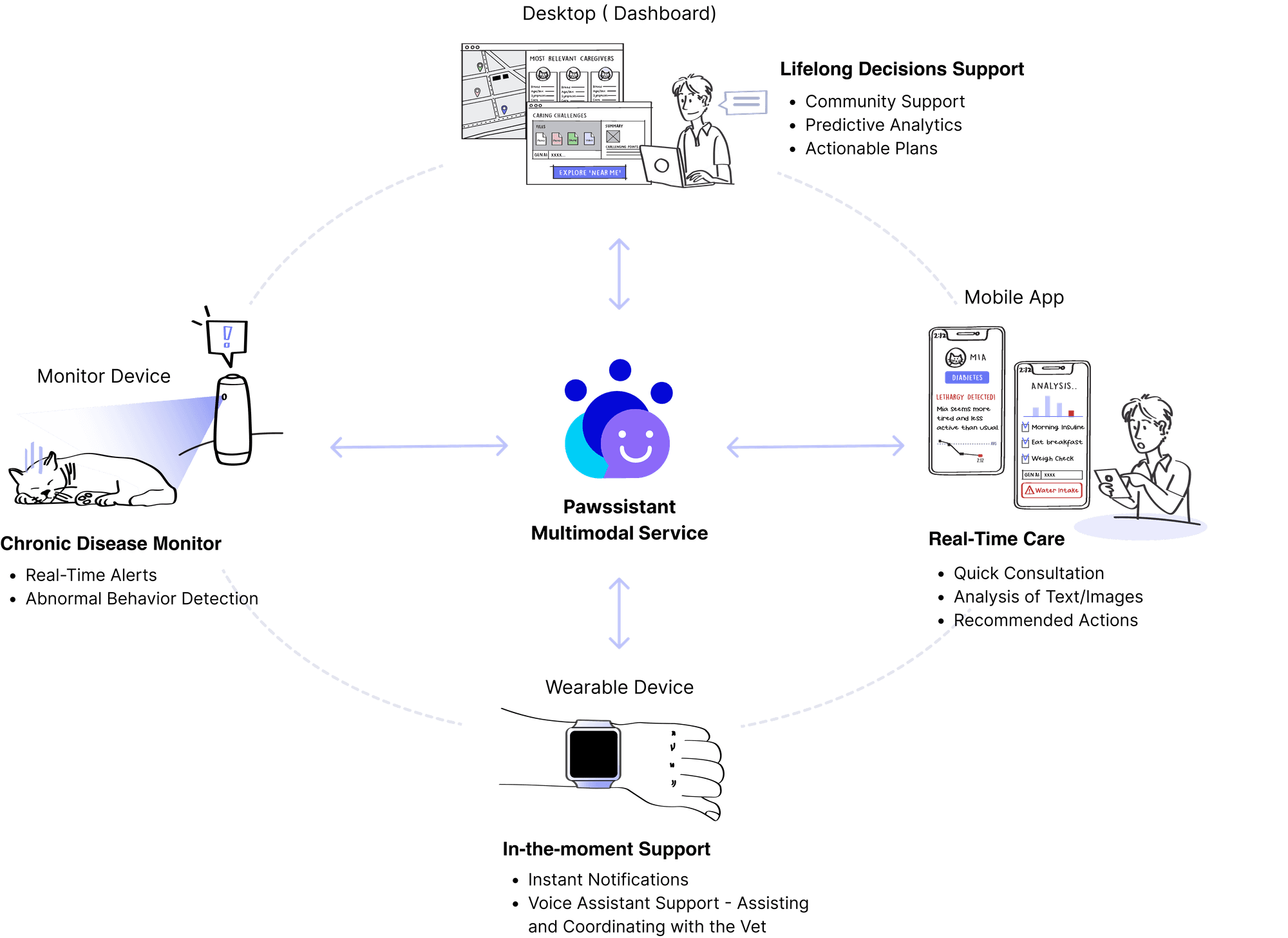
Various modes of communication and interaction help in quickly assessing pet conditions and abnormalities, making complex care tasks more manageable.


The solution
Five moments:
where Pawssistant turns data into a decision people can act on.

" Should I go to the vet or keep monitoring?
I want to weigh my decisions by cost and well-being quickly and accurately"
01: Emergency Care
The AI cross-references the pet's data and reported symptoms against a bank of similar past incidents, then returns two ranked recommendations weighing cost against risk, so the owner isn't deciding alone.
Achievable values
(1) A quick, confident decision in the moment
(2) Smarter management of emergency costs

"I don’t know how to do to save her right now! I cannot reach out the vet!"
02: In the moment support
Streamlined voice-assisted collaborative care: a hands-free voice assistant guides the owner through urgent symptoms, useful when both hands are already occupied with the pet, connects them to a vet in real time, and follows up automatically after the visit.
Achievable values
(1) Timely intervention exactly when it's needed
(2) Efficient, direct communication with the vet
"I'm worried about missing crucial changes and unsure how to care for my pets with chronic diseases."
03: Chronic Care
Smart monitoring for chronic conditions: ongoing symptom data collapses into a dashboard organized by condition, with auto-generated insights sent to the vet ahead of each visit.
Achievable values
(1) Consistent symptom tracking between visits

“I want to explore ways to ensure my pet's long-term health and making the best choice by considering consequences on a larger scale”
04: Proactive Care
Proactive care planning and financial wellness: a budget-planning estimator projects likely clinical costs against a pet's expected health trajectory.
Achievable values
(1) Decisions made years ahead of the bill
(2) Long-term health security paired with financial efficiency

“This is really stressful, I want to have some talks and know how other people do it”
05: CommuniCare
Community-driven support and advice network: surfaces nearby caregivers navigating the same condition, so owners can trade notes with someone who's actually lived it.
Achievable values
(1) Stress reduction through shared experience
(2) Emotional support an algorithm alone can't offer


The value
The AI industry is still working through the question: how much an AI should explain itself before anyone trusts it.
“I want to know where the information is coming from, and if Pawssistant can provide me from trust-worthy sources.”
00: Trust Architecture
Trust Architecture centered on our design decision. Every recommendation should cite its source, carries a disclaimer clarifying that Pawssistant assists rather than replaces a vet, and only reaches the dashboard once it's vet-approved. The goal was confidence that advice was grounded in something real, with a clear line between AI support and professional judgment.


The value
Elevating Pet Health through Early Detection and Shared Veterinary Partnerships

Our solution doesn't aim to replace a vet; instead, it focuses on early disease detection, preventing more severe and potentially fatal situations. Through accurate data collection, ensuring prompt interventions, and fostering better collaborations, we prioritize the overall well-being of pets.
Utilizes LLM technology to deliver well-informed recommendations, aiding pet owners in making complex decisions with greater confidence.
Helps pet owners gain a deeper understanding of their pets, which not only saves time but also alleviates emotional and financial stress.
Offers comprehensive, disease-focused 'Health and Care-plan mode' for efficient, lifelong management of pets' health and care needs.
The decision
Every decision was made intentionally.
Why a multimodal experience instead of one interface for everything?
A single interface can't serve an emergency, an ongoing symptom tracker, and a five-year budget decision equally well. We built separate modes, voice, dashboard, planning tool, each matched to what that moment actually needed.
Why tabs organized by condition instead of continuous feed?
Early testing showed owners couldn't find what mattered fast enough. A single running feed buried the signal. Organizing the dashboard into tabs by condition, with an expandable list for detail, cut through that clutter.
Why voice instead of text for emergency moments?
Panic doesn't leave a free hand to type. We built a real-time, voice-activated mode specifically for urgent moments, so an owner mid-emergency could get hands-free guidance exactly when it mattered most.
Why a disclaimer instead of a confident, authoritative AI voice?
An AI that sounds certain in a health crisis creates false authority. We added a disclaimer and vet-collaboration options early, making clear Pawssistant plays a supporting role, with the vet always the final word.
Interested in the full case study?
Please feel free to reach out to learn more about this work and my process in detail.
Type
Product
, Service
Date
Jan 2024
Framework & Tools
Research, Storyboard, User Journey Map, Figma, Business model & System Mapping, AI Design
Role
UI/UX+ Product Design, Business Strategy
Outcome
App & Webapp & Applewatch Design
Team
Vanessa Chang, Sunmin Ko, Eunji Kim
Advisor
Joellen Kames – UX Director in AI Cloud, Jennifer Levin – UX Strategist and Experience Lead, Motorola Solutions


Thanks for visiting!
Shoot me an email if you'd like to chat.
© Vanessa Chang 2026 | All rights reserved