Improving Healthcare Outcomes in Africa with At-Home Technology

Neopenda builds vital signs monitors for under-resourced clinical settings. The problem was that it was designed for hospitals, and the patients who needed continuous monitoring most weren't staying in hospitals — they were going home.
Award-Winning Project




Setting

The U.S. medical devices are not designed for 85% of the world’s population in emerging markets because…
They rely on continuous power & wireless connectivity.
Unreliable supply of spare parts results in frequent failure
High cost, consumables, & maintenance are unaffordable
Vision
“We expect affordable, innovative medical technologies that function in any environment.”
-Teresa Cauvel, CTO, Neopenda
Neopenda, a Chicago-based healthcare startup, had developed the Neoguard for newborns. Neoguard (the original model) is a 4-in-1 vital sign monitor for health facilities with limited resources. It accurately measures pulse rate, respiratory rate, SpO2, and temperature in babies, transmitting data to a tablet for continuous monitoring by healthcare providers.

The ask to our team was to take it further: broader age range, more body locations, more contexts beyond the hospital setting.
Problem Space
Nearly Half of Africa Left Behind: High Costs and Poor Infrastructure Limit Access to Healthcare
According to a report by the Africa Health Agenda International Conference (AHAIC), currently, less than half of the African population (48%) has access to the healthcare services they need. This is due to challenges such as high costs for healthcare, inadequate infrastructures, and poorly managed health sector resources.
70%
medical equipment sits idle in African health facilities or ends up in equipment graveyards.
2 hrs
is the average time patients live in rural areas commute to general hospitals.
43%
of deaths in Africa coming from Non-communicable diseases.
52%
African population do not have access to the healthcare services they need
Neopenda's existing product was designed for hospitals. But the people who needed it most were not getting to hospitals in the first place.

User Pain Point
Local pharmacies have become the first entry point for most of the population, leading many to go "pharmacy hopping" to get needed medication.
We examined prevalent illnesses in Africa and interviewed students from Ghana and Nigeria to understand their perspectives on healthcare experiences in their countries.
Due to the long distances from home to hospitals, high out-of-pocket charges from hospitals and doctors, as well as medical resource shortages that increase waiting times and decrease availability, local pharmacies have become the first entry point for healthcare in most areas.
Post-surgical patients, people managing chronic conditions, anyone recovering from acute illness — they leave the clinic and lose all visibility into their own health.




However, people in rural areas still suffer from various health problems, and a single-product approach is not enough to address these issues.
Limited accessibility to necessary medications causes mortality, low medication adherence, and the need for pharmacy hopping even for mild symptoms, resulting in delayed recovery and increased mortality for non-communicable diseases, ultimately leading to increased health risks and poorer overall health outcomes.


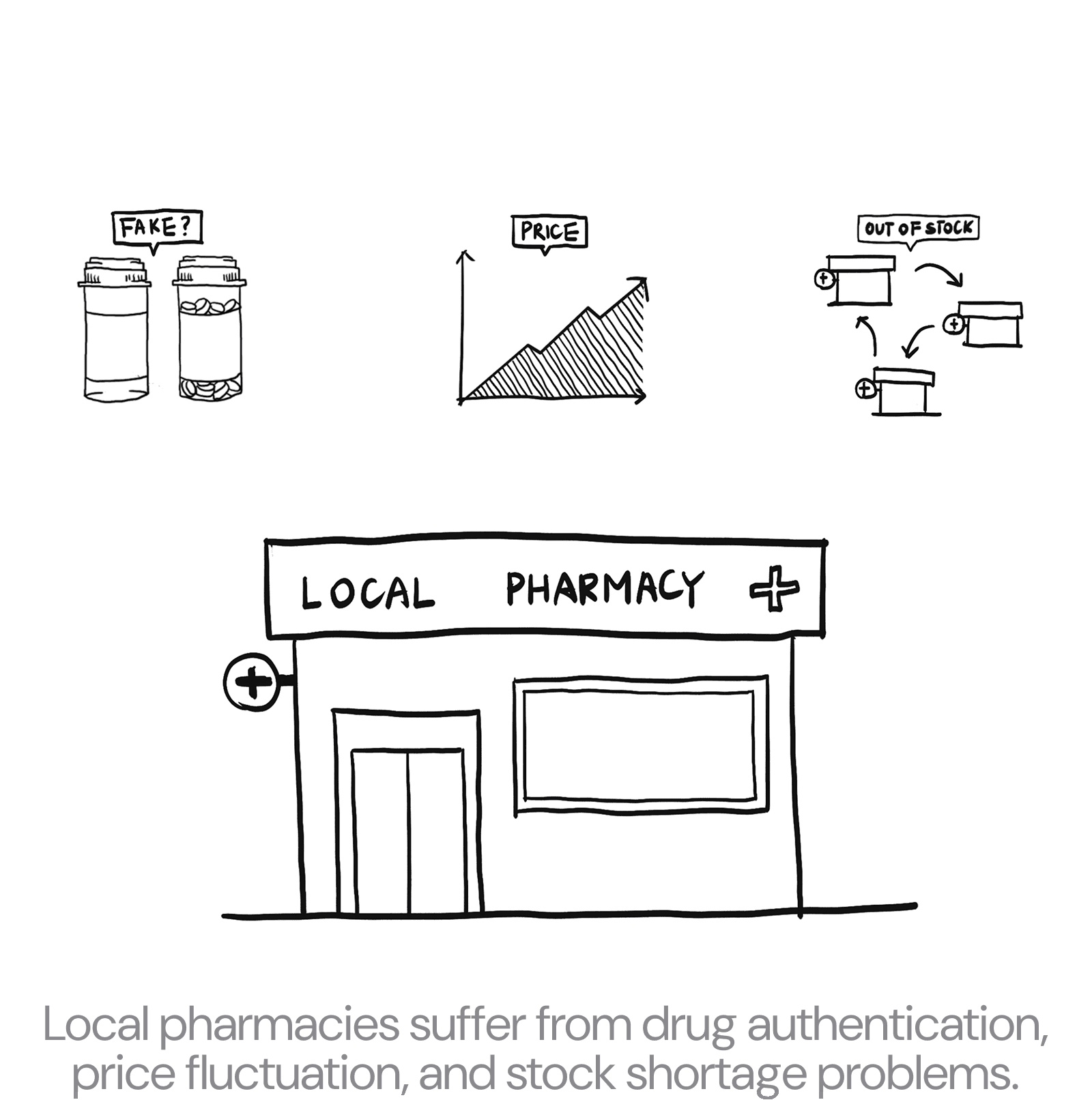
The real opportunity was to design a system that worked through the infrastructure they already used and trusted. The design challlenge was access, not hardware.
Desire State
A patient who knows whether to stay home or come back in.

The goal we designed toward: a patient wearing the device at home sees their vitals in plain numbers, understands immediately if something is wrong, and knows when to return to the pharmacy.
In order to achieve this, a local healthcare startup in Africa has brought light to the situation. mPharma, a pan-African pharmacy platform, had already built the infrastructure to support this: 850 Mutti pharmacy locations across 9 countries, 2 million patients, and a prescription system connecting doctors, pharmacists, and patients in a single flow.
mPharma's model solved medicine access. What it didn't yet include was continuous health monitoring — exactly what Neopenda existed to provide.
Solution: Overview
Introducing NeoMita:
Transforming Home-care with Innovative Ecosystem
We proposed a new business model, then built the product to make it work. The solution consists of three parts.

Part.1 : Product solution-Mita band
4-in-1 wearable tracking pulse, respiratory rate, SpO2, and temperature. Adjustable strap (20–60cm) fits infants and adults on the same device. Alerts via light and sound, no screen required. Manufacturing cost: $7.33/unit, making rental economics viable.

Part.2 : Application Solution-Mita software
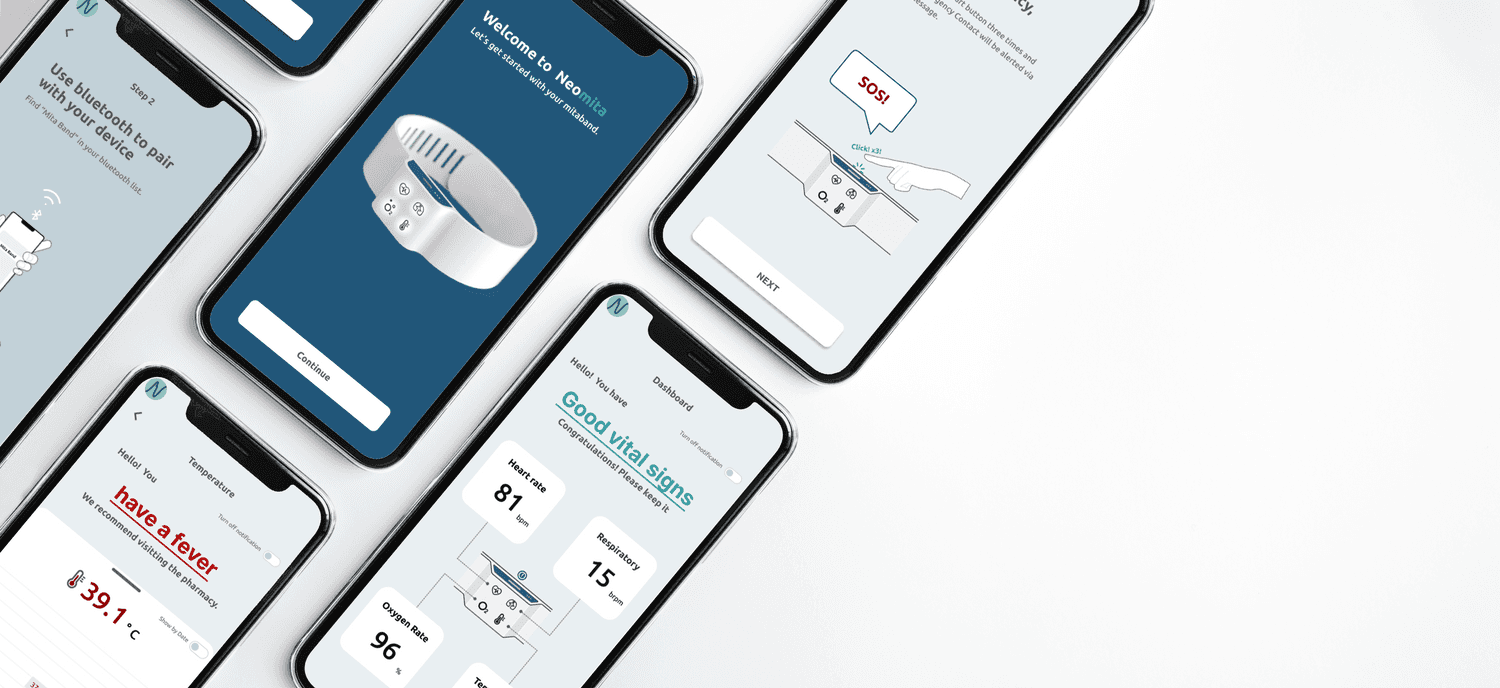
three interfaces, one data layer. NeoPatient (mobile) shows vitals in plain language and flags abnormal readings with direct guidance. NeoPharmacy (web) manages rentals and device stock. Neopenda admin (web) tracks distribution across the network.

Part.3 : A new rental-based model in collaboration with mPharma
Competitive research surfaced mPharma — a pan-African pharmacy platform with 850+ locations across 9 countries and 2 million patients. Their ambition was to become a primary healthcare provider. Their gap was continuous monitoring. Neopenda's gap was distribution. NEOMITA was designed to close both.
Solution: Product
The Mita Band: Simple and Flexible
The Mita band, tailored for all age groups, features two extendable straps along with a vital sign sensor and easy-to-use alerts for abnormal vital signs.


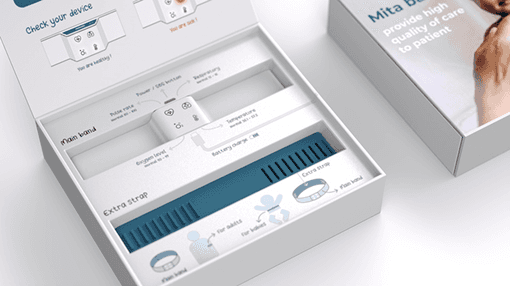


To protect the device from damage in the rental process, it is inserted into the silicone strap, allowing the LED light alerts to be visible through the silicone case so that users can see them without removing the device. Red light flashes followed by beeping sounds when vitals fall outside of normal range. Compression molding and a coin cell battery will reduce the device's size, ensuring durability and cost efficiency.
Solution: Software
The Mita-Software: Connector of all service

Solution: Business Model
The Partnership Business Model: 1+1>2

The proposed rental model contributes to a circular economy and ensures affordability.


The impact
Validated by the client, recognized by three awards.


The decisions
Every decision was made intentionally.
Why mPharma and not hospitals?
Hospitals are 2 hours or more away for most patients. Mutti pharmacies are where patients already go. We designed to the existing behavior.
Why rental instead of purchase?
A $7.33 device sold outright is still out of reach. Rented for a two-week recovery period, it's affordable, returnable, and reusable.
Why sound and light alerts instead of a screen?
Home patients can't be assumed to check an app. Most of the rural areas have low internet coverage as well. The alert works without any action from the user.
Why one strap for infants and adults?
A shared rental device serves multiple patients. One form factor had to fit a newborn's chest and an adult's arm.
Interested in the full case study?
Please feel free to reach out to learn more about this work and my process in detail.
Type
Product
, Business model
Date
Dec, 2022
Framework & Tools
Market analysis, User Journey Map, Figma, Scenarios, Business model
Role
UI/UX+ Product Design, Business Strategy
Outcome
App & Webapp & Product Design
Team
Han Wen (Vanessa) Chang, Jiwon Shin, Keval Parekh , Adelyn Soetyono
Advisor
Martin Thaler - Previous IDEO Design lead / Co-Founder / Teacher


Thanks for visiting!
Shoot me an email if you'd like to chat.
© Vanessa Chang 2026 | All rights reserved